
The Psychology Behind the 5 stages of Designing a VR Game
In every project I take on, I move through the same sequence of steps: concept art, modeling, UVs, texturing, worldbuilding, and lighting. Each one unlocks a different version of me. A different mood. A different psychology.
And recently I caught myself wondering: Which one is really my favorite? And, why?
The truth is: each stage attracts a different personality type—and yes, I seem to have all of them. Something to unpack with my therapist another day. For now, back to VR.
Here’s what each phase feels like in my opinion, what I think it says about the people who love it, and why designing VR is basically an emotional personality test disguised as a production pipeline.
1- The Concept Artist (a.k.a. The Dream Before the Mesh)
Before Blender, before Unity, before the UV heartbreak… there’s the sketch. The moodboard. The visual whisper of what the world could be. Concept art is where I allow myself to dream without constraints—no poly limits, no shader issues, no build errors. Just pure imagination with intention.
Psychology: Concept artists are visionaries. Poets with sketching pens (or Procreate brushes). They think in big feelings first, details later. They’re the ones who say, “Let’s go crazy” and then trust future-you to figure out how to actually build it.
2. The 3D Modeler (The Sculptor of Possibility)
Modeling is where the dream becomes form. It’s logical and imaginative all at once. You start with a cube, you convince it into becoming something beautiful, and suddenly you’re emotionally attached to a mesh that didn’t exist an hour ago.
This is also where the tiny inner optimizer whispers,
“Maybe don’t add another subdivision level… the Meta Quest is already sitting here judging our every move.”
Psychology: Modelers are the thinkers who also want to feel. They enjoy the balance between logic and imagination. They’re the ones who can lose hours adjusting one bevel because it just feels wrong.
They´re in love with precision and freedom.
3. The UV Unwrapper (The Mesh Therapist)
Completely separate from modeling, UV work deserves its own psychological category because it is… a journey.
UV unwrapping is where you take your perfectly sculpted object and gently peel it open like you’re unfolding its emotional baggage onto a flat map. It’s methodical. It’s calm. It’s maddening. It’s satisfying.
Psychology: UV artists are the puzzle-solvers. The patient ones. The ones who can tolerate quiet chaos and turn it into clean, logical islands. They love order. They love clarity. They’re the quiet heroes of the pipeline—because nothing textures well without their work.
4. Texture & Material Artist (Texture + Surface Know it All)
This is where I stop building shapes and start building a palette. Here, color theory becomes your emotional soundtrack:
warm tones guide players
cold tones distance them
complementary colors create tension
saturation becomes personality
And then there’s the detail work—the micro-scratches, edge wear, dust, fingerprints—that make objects feel touched, lived with, remembered.
Psychology:
Texture artists are sensorial storytellers. They paint moods and details. They’re the ones who zoom in 800% and insist on adding a detail no human eye can see but their soul apparently can.
5. The World Builder (Game Engine Integration and assembly)
Once the assets are ready, this is when I start constructing the actual environment. I position every rock, tree, and structure with intention—designing the flow of movement, the layers of depth, the environmental cues that tell players where to go without ever saying a word.
It’s interior design meets architecture meets emotional direction.
Psychology: World builders know how to read people. They put themselves in the player’s shoes and anticipate what they’ll notice, where they’ll walk, and what they’ll ignore. They design environments that guide instinct, not instructions.
6. The Lighting Artist (Where Emotion Finally Switches On)
Lighting is what tells you when and how the world exists.
Is it early sunrise? A storm coming? A cozy afternoon? A harsh neon-lit alley? The exact same environment becomes a completely different experience depending on how it’s lit. Lighting gives the world its time of day, its season, its emotional temperature.
Psychology: Lighting artists read mood through time of day and color. They know lighting decides how the world feels—before anything else does.
All in all, putting this into words made me realize something simple: being a VR artist suits me in a way I forgot existed. I’m not built for one mood, one task, one lane. Every day I wake up different, and VR allows me to be all those versions at once—creative, technical, precise, chaotic, solution-driven, imaginative. It's a space where all my moods, skills, and creative versions can coexist without apology.
And if I had to choose a favourite step, it would be worldbuilding and asset integration. That’s the moment everything I’ve made finally meets in the same space—mixing, matching, styling, arranging. It feels like hosting a reunion of my own ideas.
Sometimes, on the days when my creativity is tired of being creative, I drift into UV unwrapping. It’s quiet, and believe it or not almost comforting. No overthinking, no improvising—just right or wrong, aligned or not. A small layer of order inside a job that otherwise asks me to imagine entire worlds.
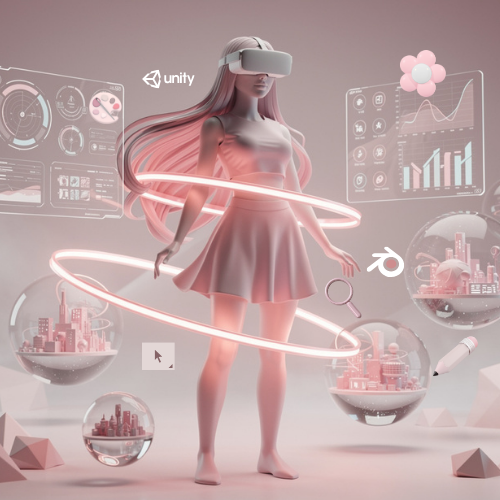
*Image Generated with Gemini Nano Banana, Edited on Canva